Richmond, VA

100 Miles Of Coverage

Sundays

Only for emergencies

24/7

Emergency Service

Plumbing

Virginia Code Requirements for Grease Traps in Food Service Facilities

Plumbing (5)

If you own or operate a food service facility in Richmond, VA — whether it’s a full-service restaurant, a commercial kitchen, a bakery, a school cafeteria, or a food truck commissary — grease trap compliance is not optional. Virginia’s plumbing code and local municipal regulations require that food service establishments install and maintain properly sized grease interceptors to prevent fats, oils, and grease from entering the public sewer system. Failing to comply can result in fines, forced shutdowns, and significant liability if sewer backups cause damage to neighboring properties.

At Cordova’s Plumbing LLC, we install and service grease interceptors for food service facilities throughout Richmond, VA and the surrounding area. Here’s everything you need to know about Virginia’s requirements — before you build, renovate, or open your doors.


Why Grease Traps Are Required by Virginia Code

Fats, oils, and grease — collectively known as FOG — are a byproduct of virtually every food service operation. When FOG enters the sewer system, it cools, solidifies, and accumulates on the interior walls of drain pipes and sewer mains, eventually causing blockages that can result in sewage backups affecting entire neighborhoods.

  • The Virginia Uniform Statewide Building Code (USBC) and the Virginia Plumbing Code both mandate grease interceptor installation for food service facilities based on the type of operation and the volume of FOG the facility is expected to generate
  • Richmond’s Department of Public Utilities enforces a Fats, Oils, and Grease (FOG) Control Program that requires food service establishments to install, maintain, and periodically report on their grease interceptor systems
  • A grease interceptor that is improperly sized, poorly maintained, or absent entirely is one of the leading causes of sanitary sewer overflows — events that carry significant environmental, health, and financial consequences for the business responsible
  • In addition to state and local code requirements, many commercial property leases include grease management clauses that make the tenant responsible for maintaining a compliant grease interceptor throughout their occupancy

Understanding why these requirements exist makes it easier to approach compliance as the protective measure it is — for your business, your neighbors, and the public sewer infrastructure your facility depends on.


Which Food Service Facilities Are Required to Have a Grease Trap in Virginia

Virginia’s code casts a broad net when it comes to which types of food service operations require a grease interceptor. If your facility prepares, cooks, or serves food, the requirement almost certainly applies to you.

  • Full-service restaurants and fast food operations of any size
  • Commercial bakeries and pastry kitchens
  • School, hospital, and institutional cafeterias
  • Hotel and catering kitchen facilities
  • Food truck commissaries and shared commercial kitchens
  • Grocery stores with deli, meat, or prepared food departments
  • Breweries, wineries, and distilleries with food preparation areas
  • Any tenant in a commercial space who installs a commercial cooking operation, regardless of whether the previous tenant had one

The requirement applies to new construction, renovations that involve kitchen plumbing modifications, and existing facilities that change their use to include food preparation. If you’re unsure whether your specific operation requires a grease interceptor, a licensed plumber can review your plans and give you a definitive answer before you build.


Types of Grease Interceptors Approved Under Virginia Code

Virginia’s plumbing code recognizes two primary types of grease interceptors, each suited to different facility sizes and FOG generation volumes.

  • Hydromechanical grease interceptors (HGIs) — smaller, indoor units typically installed under a sink or in a floor vault near the kitchen; suitable for lower-volume operations; must be listed and labeled in accordance with ASME A112.14.3 or PDI G101 standards; require more frequent cleaning — typically every one to three months depending on usage
  • Gravity grease interceptors (GGIs) — large, in-ground concrete or fiberglass tanks installed outside the building or beneath the slab before it is poured; required for higher-volume operations and preferred by Richmond’s public utilities department for most full-service restaurant applications; must be sized to handle the facility’s peak FOG load and are typically pumped out every 30 to 90 days depending on capacity and usage

The type and size of interceptor required for your specific facility is determined during the permit review process based on your menu, cooking methods, kitchen equipment, and the number of meals served per day. A licensed plumber who works regularly with food service facilities can help you determine which option is appropriate before you submit your permit application.


Sizing Requirements: How Virginia Determines the Right Capacity

One of the most common compliance mistakes food service operators make is installing a grease interceptor that is too small for their actual FOG generation volume. Virginia’s code provides specific sizing calculations that must be followed.

  • Gravity grease interceptors are sized based on drainage fixture units (DFUs) — a calculation that accounts for the number and type of fixtures discharging into the interceptor, including sinks, floor drains, dishwashers, and cooking equipment connections
  • The Virginia Plumbing Code references the Uniform Plumbing Code (UPC) sizing tables, which establish minimum liquid capacity based on the total DFU load discharging into the unit
  • Richmond’s FOG Control Program may impose additional sizing requirements beyond the minimum code standard for high-volume operations such as large restaurants, institutional kitchens, or facilities that fry extensively
  • Undersized interceptors fill with grease faster than they can be pumped, allowing FOG to pass through into the sewer system — defeating the purpose of the device and leaving the facility out of compliance even if the interceptor was permitted and installed
  • A licensed plumber calculates the correct interceptor size as part of the permit application process, ensuring the installed unit meets both state code minimums and any additional local requirements that apply to your facility

Getting the sizing right from the beginning is far less expensive than replacing an undersized unit after it fails inspection or causes a sewer backup.


Installation Requirements Under Virginia Code

The physical installation of a grease interceptor must meet specific code requirements that govern its location, access, and connection to the facility’s drain system.

  • Gravity grease interceptors must be installed outside the building or in a location approved by the local building authority, with accessible cleanout covers that allow pumping without entering the facility or disturbing food preparation areas
  • The interceptor must be set at the correct depth and orientation to maintain the designed flow-through rate and separation efficiency
  • All kitchen fixture drain lines that discharge FOG — including pot sinks, floor drains, pre-rinse spray stations, and cooking equipment connections — must be routed through the interceptor; dishwashers using high-temperature sanitizing cycles are typically excluded per manufacturer and code guidance
  • A flow control fitting must be installed on the inlet line to regulate the rate at which wastewater enters the interceptor, preventing turbulence that reduces separation efficiency
  • The outlet line from the interceptor connects to the building’s sanitary sewer at a point downstream of the interceptor, with a cleanout installed at the connection point
  • All installations must be permitted and inspected by Richmond’s building authority before the interceptor is covered or placed into service

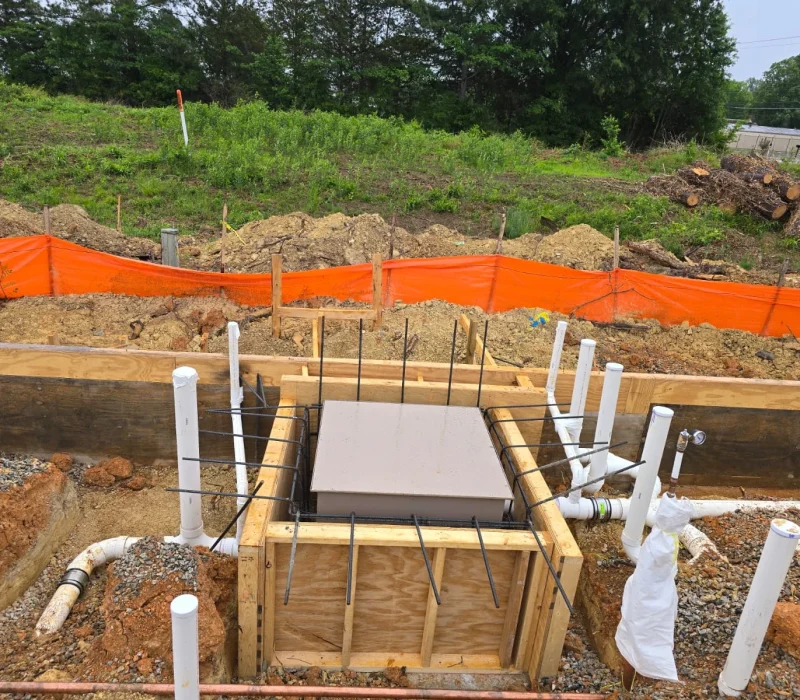
In new construction, the grease interceptor is typically set and connected during the underground rough-in phase — before the slab is poured — making early coordination between the plumbing contractor and the general contractor essential to avoid costly schedule delays.


Ongoing Maintenance and Reporting Requirements

Installing a compliant grease interceptor is only the first step. Virginia’s code and Richmond’s FOG Control Program impose ongoing maintenance and reporting obligations that food service operators must meet throughout the life of their business.

  • Gravity grease interceptors must be pumped by a licensed waste hauler on a schedule determined by the rate at which the unit reaches 25% capacity with accumulated grease — Richmond’s FOG program uses this threshold as the standard for required pumping
  • Maintenance records, including pump-out dates, volumes removed, and the name of the licensed hauler, must be kept on site and made available to city inspectors upon request
  • Richmond’s Department of Public Utilities conducts periodic inspections of food service facilities to verify interceptor condition and compliance with maintenance schedules
  • Facilities that fail inspections or are found to be discharging FOG in excess of permitted levels may be subject to fines, required to upgrade their interceptor capacity, or referred for enforcement action
  • Any modifications to the kitchen layout, equipment, or drain connections that affect the FOG load on the interceptor must be reported and may require a permit and updated sizing calculation

Staying current with maintenance requirements protects your business from enforcement action and ensures your interceptor performs the function it was designed for.


Final Thoughts

Grease trap compliance in Virginia is not a bureaucratic formality — it’s a practical requirement that protects your business, your building, and the public sewer infrastructure that every food service operation in Richmond depends on. Getting it right from the start means working with a licensed plumber who understands the code, knows Richmond’s local requirements, and has the experience to size, install, and document your grease interceptor correctly the first time.

At Cordova’s Plumbing LLC, we’ve handled grease interceptor installations for food service facilities throughout Richmond, VA and the surrounding area. We manage the permitting process, coordinate with your construction team, and deliver an installation that passes inspection and keeps your business in compliance from day one.


Opening or renovating a food service facility in Richmond, VA? Contact Cordova’s Plumbing LLC today for a professional consultation on grease interceptor requirements and installation. Licensed, insured, and available throughout Richmond and the surrounding 100-mile area.
Share This :

When you choose us, you’re not just hiring a contractor. You’re gaining a trusted partner with over 10 years of experience, licensed and insured service, and a commitment to quality and customer satisfaction.
Info