Commercial drinking fountains and bottle filling stations are a standard fixture in office buildings, schools, healthcare facilities, retail spaces, and any commercial property that serves employees or the public. They look simple from the outside — push a button, get water. But behind every properly functioning commercial drinking fountain is a carefully planned plumbing connection that ties into the building’s water supply system, meets Virginia’s code requirements, and delivers clean, adequately pressured water consistently throughout the life of the building.
At Cordova’s Plumbing LLC, we install and service commercial plumbing fixtures throughout Richmond, VA and the surrounding area. Here’s a detailed look at how commercial drinking fountains are plumbed into a building’s water supply — and what it takes to do the job correctly.
Planning the Installation: Location, Code, and ADA Requirements
Before any pipe is run or any fixture is mounted to a wall, the installation must be planned carefully to meet both Virginia’s plumbing code and federal ADA accessibility standards.
- Location selection is not arbitrary — drinking fountains in commercial buildings must be placed in accessible locations that meet ADA clearance requirements for approach space, reach range, and knee clearance beneath the unit
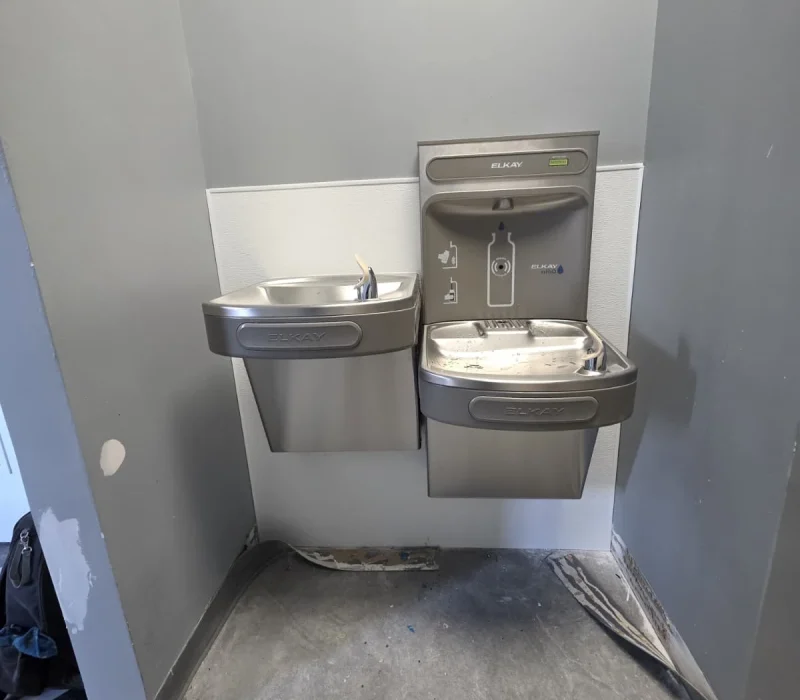
- ADA standards require that at least one drinking fountain in a commercial facility be mounted at a height accessible to wheelchair users, while a second unit serves standing users; combination units like the Elkay dual-height models satisfy both requirements with a single installation
- Virginia Plumbing Code specifies the minimum number of drinking fountains required based on occupancy type and the number of people the building is designed to serve
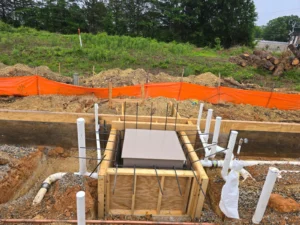
- Rough-in dimensions — the precise height and location of the water supply stub-out and drain connection in the wall — must be determined before framing is complete and walls are finished, making early coordination between the plumber and the general contractor essential
- Bottle filling stations have additional requirements, including a drain connection for the overflow sensor and, in many cases, a filtration system connection that must be accounted for in the rough-in layout
Getting these decisions right during the planning phase prevents costly wall openings and relocations after finishes are in place.
The Water Supply Connection
The water supply connection is the core of any drinking fountain installation — it determines whether the unit receives adequate flow and pressure to perform correctly under the demands of daily commercial use.
- A dedicated cold water supply line is run from the building’s main distribution system to the fountain location, typically using copper or PEX tubing sized to meet the fixture’s flow rate requirements
- A shutoff valve is installed at the supply connection point directly behind or beneath the unit, allowing the fountain to be isolated for service or replacement without interrupting water supply to the rest of the building
- Water pressure at the fixture must fall within the manufacturer’s specified range — too low and the fountain produces an inadequate stream; too high and it can damage internal components or create splashing that defeats the purpose of the unit
- A pressure-reducing valve may be required at the supply connection if the building’s main supply pressure exceeds the fountain’s rated maximum, which is common in commercial buildings served by high-pressure municipal mains
- For bottle filling stations with integrated filtration systems, the supply line must also accommodate the filter housing connection, which adds a small pressure drop that must be factored into the supply line sizing
- All supply connections are pressure-tested after installation to confirm there are no leaks before the wall is closed or the unit is put into service
Proper supply line sizing and pressure management are what separate a fountain that performs reliably for years from one that frustrates users with weak streams or frequent maintenance calls.
The Drain Connection
Every commercial drinking fountain requires a drain connection to carry away overflow water, splash, and the continuous slow drain that keeps the fountain basin clear during use.
- The drain line connects from the fountain’s built-in drain fitting to the building’s sanitary drain system through a standard P-trap configuration that prevents sewer gases from entering the building through the fixture
- Wall-mounted fountains typically connect to a drain stub-out roughed into the wall during framing, while floor-mounted pedestal units connect to a floor drain or a floor-level wall stub-out
- The drain line must maintain adequate slope from the fixture to the main drain to prevent standing water in the line, which can cause odors and bacterial growth over time
- Floor drains positioned beneath or adjacent to drinking fountains are common in commercial installations to catch overflow and splashing that the fixture’s built-in drain doesn’t capture
- In renovation projects where a drinking fountain is being added to an existing space, drain connections sometimes require core drilling through concrete floors or wall demolition to reach existing drain lines — work that a licensed plumber must plan and execute carefully to avoid damaging structural elements or existing utilities
The drain system is often the most overlooked aspect of a drinking fountain installation — but a poorly executed drain connection is one of the most common causes of odor complaints and maintenance issues in commercial facilities.
Filtration and Water Quality Considerations
Modern commercial drinking fountains — particularly bottle filling stations — are frequently specified with integrated filtration systems that require additional plumbing considerations during installation.
- Inline water filters are installed on the supply line between the shutoff valve and the fountain, typically in an accessible location that allows filter cartridge replacement without disturbing the fixture or the wall
- Filter housings must be oriented and positioned according to manufacturer specifications to ensure proper flow direction and easy serviceability
- A bypass valve is recommended on filtered installations so the water supply to the fountain can be maintained during filter changes without shutting off the supply line entirely
- Lead filtration is an increasingly common specification for commercial drinking fountains, particularly in older buildings where supply lines may contain legacy materials; NSF/ANSI 53-certified filters are specified for lead reduction
- In facilities where water quality is a significant concern — schools, healthcare facilities, and food service environments — a licensed plumber may recommend a point-of-use filtration system that serves multiple fixtures from a single filter bank rather than individual filters at each fountain
Addressing water quality at the installation stage, rather than retrofitting filtration later, is always the more cost-effective approach.
Final Thoughts
A commercial drinking fountain may be one of the smaller fixtures in a building’s plumbing system — but its installation involves the same principles of proper supply sizing, code compliance, drain system design, and water quality management that govern every other aspect of commercial plumbing. Done correctly, a properly plumbed drinking fountain or bottle filling station serves a building’s occupants reliably for decades with minimal maintenance. Done incorrectly, it becomes a source of ongoing service calls, water damage, and code violations.
At Cordova’s Plumbing LLC, we bring the same level of care and professionalism to commercial fixture installations of every size — because every connection we make reflects the standard of work we stand behind.
Need commercial plumbing fixture installation in Richmond, VA?
Contact Cordova’s Plumbing LLC today — licensed, insured, and experienced in commercial plumbing projects of all types throughout Richmond and the surrounding area.
📞 Call us at (804) 974-5484 or contact us online to get started.