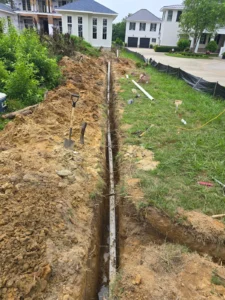
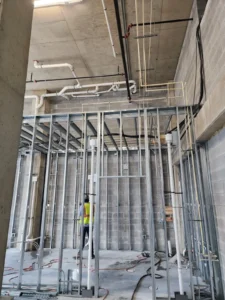
When a property development project breaks ground in Richmond, VA, the work that happens in the first few weeks sets the tone for everything that follows. Before concrete is poured, before steel goes up, and before any above-ground trade touches the site, underground plumbing crews are in the trenches — literally — installing the sewer mains, water service lines, and storm drainage infrastructure that the entire development will depend on for decades.
Deep trench plumbing is one of the most technically demanding and logistically complex phases of any development project. It requires heavy equipment, precise engineering, strict safety protocols, and experienced plumbing contractors who understand both the underground environment and the coordination demands of a large, active construction site.
At Cordova’s Plumbing LLC, we bring that experience to commercial and residential development projects throughout Richmond, VA and the surrounding area. Here’s what property developers need to know before the excavators start moving dirt.
What Deep Trench Plumbing Involves
Deep trench plumbing refers to the installation of underground pipe systems at depths that go significantly below the building’s footprint — typically driven by the need to reach the municipal sewer connection point, maintain proper drainage slope over long runs, or install infrastructure beneath roadways, parking areas, and other hardscape.
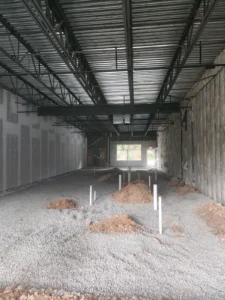
- On many commercial development sites in Richmond, VA, sewer mains must be installed at depths of 8 to 15 feet or more to connect to existing municipal infrastructure at the correct invert elevation
- At those depths, trench excavation requires tracked excavators and careful soil management — Richmond’s clay-heavy red soil requires specific shoring and trench protection measures to prevent wall collapse
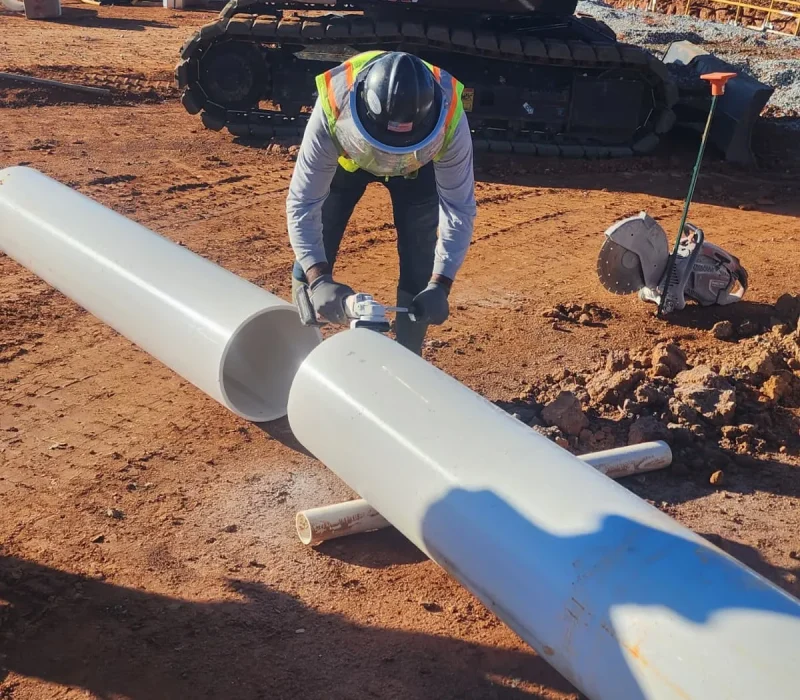
- Large diameter PVC, ductile iron, or reinforced concrete pipe sections are staged on the surface, fitted, and lowered into position using excavator attachments or dedicated pipe-laying equipment
- Joint assembly at depth requires experienced plumbers working in confined conditions to ensure watertight connections that will perform correctly under the loads imposed by backfill, traffic, and ground movement above them
- Once pipe sections are set and connected, the line is surveyed for grade and alignment before any backfill is placed — a deviation of even a fraction of an inch per foot from the design slope can cause long-term drainage problems that are extraordinarily expensive to correct after the trench is closed
The combination of depth, pipe size, soil conditions, and coordination complexity makes deep trench plumbing work that demands specialized experience — not just general plumbing knowledge applied to a larger job.
Engineering, Permits, and Pre-Construction Requirements
Deep trench plumbing on a development site doesn’t begin with a shovel — it begins with a substantial amount of engineering, permitting, and coordination work that must be completed before excavation starts.
- Civil engineering drawings prepared by a licensed engineer establish the precise alignment, depth, slope, and size of every underground pipe run on the site, along with the locations of manholes, cleanouts, and connection points to municipal infrastructure
- Utility locating — commonly known as calling 811 — is required by Virginia law before any excavation begins; all existing underground utilities on and adjacent to the site must be marked to prevent potentially fatal strikes during digging
- Encroachment permits are required from the Virginia Department of Transportation (VDOT) or the City of Richmond when underground work crosses or runs beneath public rights-of-way, which is common on development sites that require new utility connections to existing street-level infrastructure
- Tap permits from Richmond’s Department of Public Utilities authorize the physical connection of the new development’s sewer and water systems to the municipal mains — these permits must be in hand before connection work begins
- OSHA trench safety compliance — any trench deeper than 5 feet requires a protective system such as shoring, sloping, or a trench box; at the depths common to commercial development work, these systems are engineered rather than standard and must be installed and inspected before workers enter the excavation
- Stormwater pollution prevention plans (SWPPP) address how the project will manage sediment and runoff during excavation — Richmond’s clay soils are particularly prone to erosion, and SWPPP compliance is enforced by the Virginia Department of Environmental Quality
Developers who underestimate the pre-construction requirements for deep trench work frequently encounter permit delays, stop-work orders, and schedule disruptions that could have been avoided with proper planning from the beginning.
Coordination With Heavy Equipment and Other Site Trades
Deep trench plumbing on a large development site is not a solo operation — it requires constant coordination with excavation crews, site supervisors, surveyors, and other trades working in proximity to the open trench.
- Excavation and plumbing crews must work in sequence — the excavator opens the trench to the design depth and grades the trench bottom, the plumbing crew sets pipe and makes connections, and the excavator backfills and compacts before moving to the next section
- A site surveyor or grade checker verifies pipe elevation and alignment at regular intervals during installation, confirming that each section meets the design grade before it is covered
- Concrete crews installing footings and grade beams must coordinate their work around the plumbing layout to avoid placing structural elements that conflict with pipe runs or access points
- On active sites with multiple trades working simultaneously, the underground plumbing contractor must communicate clearly with the general contractor about trench locations, equipment swing zones, and areas where ground loading from heavy equipment must be restricted to protect freshly installed pipe
- Material staging — positioning large pipe sections, fittings, and bedding gravel near the active trench without blocking equipment access or creating hazards — requires careful logistical planning on sites where space is limited
Experienced commercial plumbing contractors like Cordova’s Plumbing LLC bring established coordination protocols to these environments, reducing the friction between trades that causes the delays and rework that inflate project costs.
Richmond-Specific Considerations for Deep Trench Work
Every market has soil, infrastructure, and regulatory characteristics that affect how underground work is planned and executed. Richmond, VA presents a specific set of conditions that developers and their plumbing contractors must account for.
- Richmond’s clay-heavy soils expand when wet and contract when dry, creating ground movement that affects trench stability during excavation and long-term pipe alignment after backfill; pipe bedding specifications in this environment call for carefully graded aggregate rather than native soil to provide stable, non-shrinking support
- Existing infrastructure density in established Richmond neighborhoods means development sites near the urban core frequently encounter undocumented or poorly mapped legacy utilities — water mains, gas lines, and storm drains from earlier eras — that don’t appear on current utility maps and must be carefully exposed by hand before mechanical excavation proceeds
- Municipal connection depth varies significantly across Richmond’s sewer system based on topography and the age of the infrastructure; some areas of the city require connections at depths that classify the work as confined space entry under OSHA standards, requiring specific training, equipment, and atmospheric monitoring
- Seasonal weather affects trench work scheduling — Richmond’s spring rainy season can destabilize open trenches rapidly, and summer heat creates worker safety considerations that must be built into site planning
- Richmond’s inspections process for underground utility work requires coordination with the city’s building and utilities departments at multiple hold points before work can proceed — developers who work with plumbing contractors unfamiliar with Richmond’s specific inspection sequence often experience avoidable delays
Local knowledge of these conditions isn’t a secondary consideration — it’s one of the most important factors in keeping a deep trench plumbing project on schedule and on budget in the Richmond market.
What to Look for in a Deep Trench Plumbing Contractor
Not every licensed plumber is equipped to handle the scale, complexity, and safety demands of deep trench work on a commercial development site. When evaluating plumbing contractors for a development project in Richmond, VA, developers should look for the following.
- Virginia Class A contractor’s license — deep trench and large-scale commercial plumbing work requires a Class A classification, which authorizes work of unlimited value and complexity
- Documented experience on comparable projects — ask for references from developers or general contractors on similar projects in the Richmond market; a contractor with residential experience but no commercial development background is not the right fit for this work
- OSHA trench safety training and compliance history — verify that the contractor’s field supervisors hold current OSHA 30-hour construction safety certifications and that the company has a documented safety program
- Coordination with civil engineers and site surveyors — the best commercial plumbing contractors work directly with your project’s engineering team from the pre-construction phase, reviewing drawings and flagging constructability issues before they become field problems
- Local relationships with Richmond’s permitting and inspection authorities — a contractor who knows the city’s process, knows the inspectors, and has a track record of passing inspections the first time adds measurable value to any development timeline
These qualifications separate contractors who can handle the work from those who will struggle with it — and on a development project, that difference shows up directly in your schedule and your budget.
Final Thoughts
Deep trench plumbing is where development projects are won or lost underground. The systems installed in those trenches — sewer mains, water service lines, storm drainage infrastructure — are the foundation of everything built above them, and they will serve the development for the life of the structures that depend on them. Getting that work right requires engineering precision, safety expertise, heavy equipment coordination, and the kind of local knowledge that only comes from years of working in Richmond’s specific soil, regulatory, and infrastructure environment.
At Cordova’s Plumbing LLC, we bring all of that to every development project we take on — from the first utility locate to the final inspection approval.
Planning a development project in Richmond, VA? Contact Cordova’s Plumbing LLC today to discuss your underground plumbing needs. Licensed, insured, and experienced in large-scale commercial and residential development plumbing throughout Richmond and the surrounding 100-mile area.