Most homeowners and business owners think of gas plumbing as a straightforward system — gas comes in from the street, travels through a pipe, and feeds your appliances. And for a simple residential setup with a furnace, water heater, and stove, that description isn’t far off. But as properties grow in size and complexity — multi-unit buildings, large custom homes, commercial facilities — the gas distribution system has to evolve with them. That’s where gas manifold systems come in.
At Cordova’s Plumbing LLC, we design and install complex gas distribution systems for residential and commercial properties throughout Richmond, VA and the surrounding area. Here’s what a gas manifold system is, why it matters, and how professional plumbers use it to organize gas installations that serve multiple zones and appliances safely and efficiently.
What Is a Gas Manifold System?
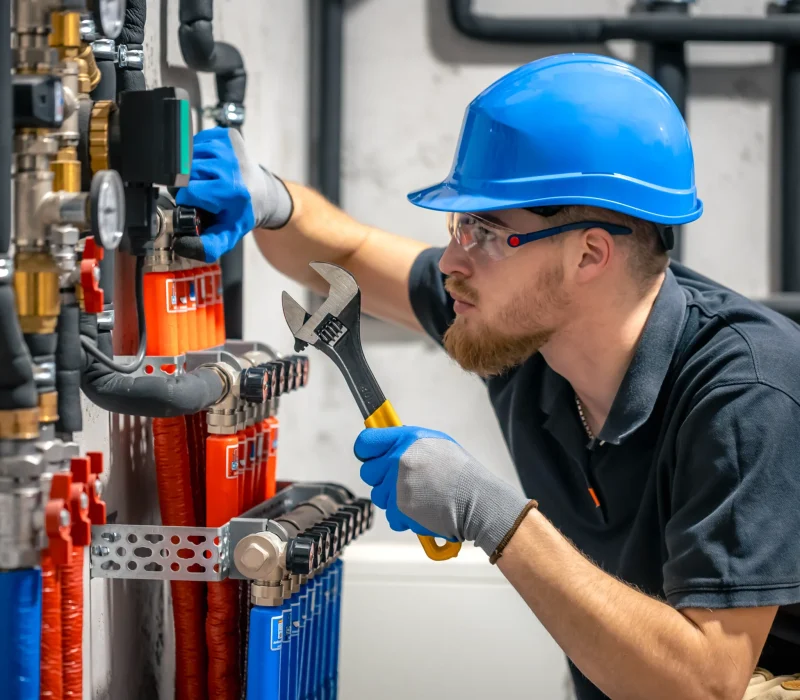
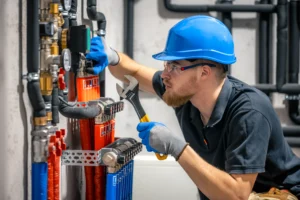
A gas manifold is a central distribution hub that receives gas from the main supply line and splits it into multiple dedicated branch lines, each serving a specific appliance or zone within the property.
- Rather than running a single large gas line that branches off at multiple points throughout the building — each branch reducing the pipe size and potentially the pressure available to downstream appliances — a manifold consolidates all distribution at one controlled location
- Each branch line leaving the manifold has its own dedicated shutoff valve, allowing any individual appliance or zone to be isolated for service, repair, or replacement without interrupting gas supply to the rest of the building
- Pressure gauges installed on or near the manifold allow a licensed plumber to monitor system pressure at the distribution point and identify pressure drops that indicate a leak or restriction somewhere in the system
- The manifold itself is typically installed in a mechanical room, utility space, or dedicated gas equipment enclosure that is accessible for inspection and maintenance but protected from accidental damage
- In commercial properties and large residential installations, the manifold may serve dozens of branch lines simultaneously — each color-coded, labeled, and valved individually for clear identification and safe operation
The manifold approach transforms a gas distribution system from a web of branching pipes spread throughout a building into an organized, centrally managed infrastructure that is far easier to inspect, service, and expand over time.
Why Manifold Systems Are Used in Complex Installations
For simple properties with just a few gas appliances, individual branch lines running directly from the main supply are often sufficient. But as the number of appliances, the size of the property, or the complexity of the gas demands increases, a manifold system becomes the professional standard for several important reasons.
- Consistent pressure across all zones — a properly designed manifold ensures that each branch line receives adequate gas pressure regardless of what other appliances are running simultaneously; without a manifold, high-demand appliances drawing gas upstream can starve downstream fixtures of the pressure they need to operate correctly
- Simplified troubleshooting — when a pressure issue or suspected leak arises in a complex system, a manifold with individual shutoff valves and pressure gauges allows a licensed plumber to isolate and test each branch line independently, pinpointing the problem quickly without disrupting the entire system
- Easier future expansion — a manifold designed with additional valve ports allows new appliances or zones to be added to the system without reconfiguring the main distribution pipe; the new branch simply connects to an available port at the manifold
- Code compliance in commercial settings — Virginia’s commercial gas code and the National Fuel Gas Code (NFPA 54) both include specific requirements for gas distribution systems in commercial buildings that a properly designed manifold system is built to satisfy
- Centralized emergency shutoff capability — in addition to individual branch valves, the manifold installation includes a main shutoff that can cut gas to all branches simultaneously in an emergency, giving occupants and first responders a single, clearly identified control point
These advantages make the manifold approach the professional standard for any gas installation that goes beyond the simplest residential setup.
Key Components of a Professional Gas Manifold Installation
A well-executed gas manifold system involves more than just a pipe fitting with multiple outlets. Each component plays a specific role in ensuring the system operates safely, reliably, and in compliance with Virginia’s gas code.
- Main supply line and pressure regulator — gas enters the manifold from the building’s main supply line at the regulated pressure set by the utility; a secondary regulator at the manifold may further reduce pressure for specific branch lines serving appliances with lower BTU requirements
- Manifold body — typically constructed from black steel, brass, or approved stainless steel fittings, the manifold body must be rated for the operating pressure of the system and compatible with natural gas or propane as applicable
- Individual ball valves — each branch line leaving the manifold has a full-port ball valve that provides a positive shutoff; these valves must be accessible, properly labeled, and operable without tools in an emergency
- Pressure gauges — installed at the manifold inlet and at key points in the distribution system, pressure gauges allow continuous monitoring of system pressure and provide immediate indication of pressure loss that may signal a leak
- Flexible connectors and CSST — branch lines running from the manifold to individual appliances often use corrugated stainless steel tubing (CSST) for its flexibility and ease of routing through walls and mechanical spaces; CSST installations must be bonded and grounded per Virginia code to protect against arc damage from lightning
- Sediment traps — installed on branch lines serving appliances with gas valves and controls, sediment traps catch pipe scale, debris, and moisture before they reach sensitive appliance components
- Identification labeling — every branch line and valve at the manifold must be clearly labeled to identify which appliance or zone it serves; in commercial installations, color-coding is often used alongside labels for rapid identification
Each of these components must be selected, sized, and installed by a licensed gas plumber who understands both the engineering requirements of the system and Virginia’s applicable code standards.
Gas Manifold Systems in Commercial vs. Residential Applications
While the principles behind a gas manifold system are the same regardless of the property type, the scale, complexity, and code requirements differ significantly between commercial and residential applications.
- Residential manifold systems are most common in large custom homes, properties with multiple heating zones, outdoor kitchen and fire feature connections, whole-home generator hookups, or any situation where more than four or five gas appliances need to be served from a single main supply
- Commercial manifold systems serve a much wider range of applications — restaurants with multiple cooking stations, industrial facilities with process gas equipment, multi-unit residential buildings, healthcare facilities, and any commercial property where gas demand is high and zone isolation is operationally important
- Commercial installations are subject to more extensive permit requirements, formal engineering review, and mandatory inspection at multiple stages of the installation — all of which Cordova’s Plumbing LLC manages as part of our commercial gas plumbing service
- In both residential and commercial settings, the manifold installation must be documented with an as-built drawing that shows the location of each branch line, the appliance it serves, and the valve that controls it — a critical reference for future service work and emergency response
Whether the project is a custom home in the Richmond suburbs or a commercial facility in the city, the manifold system that organizes its gas distribution reflects the professionalism and precision of the plumbing contractor who designed and installed it.
Final Thoughts
A gas manifold system is one of the clearest examples of the difference between a gas installation that merely works and one that is designed to perform reliably, safely, and efficiently for the life of the building it serves. The organization, accessibility, and control that a properly engineered manifold provides aren’t luxuries — they’re the professional standard for any complex gas installation, and they make every subsequent inspection, service call, and system expansion dramatically simpler and safer.
At Cordova’s Plumbing LLC, we bring that level of professionalism to every gas plumbing project we take on in Richmond, VA — from the initial design through the final pressure test and inspection.